 CareerCRM
What is the hidden job market?
The hidden job market refers to all the positions that get filled without a public posting on LinkedIn, Indeed, or any other job board. These roles are filled through internal promotions, employee referrals, direct networking from candidates, or proactive recruiting — sometimes before the official headcount is even approved.
The exact percentage varies by industry and seniority level, but estimates consistently put the hidden market at 70–85% of all hires. At the senior level, the number is even higher — the more senior the role, the less likely it is to be posted publicly before it's filled.
Why does the hidden job market exist?
Companies avoid public postings for several reasons:
- Referrals are faster and cheaper. An employee referral can close in 2-3 weeks. A public posting can take 3+ months. Referred candidates also tend to have better retention — they know what they're walking into.
- Confidential replacements. Companies don't always post a role when replacing someone who hasn't left yet. The hire happens quietly through the recruiter's existing network.
- Headcount isn't finalized. A manager wants to hire someone great before budget is approved. If the right person appears through a relevant conversation, the role gets created for them.
- Avoiding public competition. Some companies don't want to signal to competitors that they're growing a specific function.
- Warm talent pools. Good recruiters and hiring managers maintain relationships with candidates they've met before. When a need arises, they reach out to their warm list first.
5 strategies to access the hidden job market
1. Build a target company list and work it proactively
Instead of searching for job postings, start with companies. Build a list of 20-40 organizations you'd genuinely want to work at. For each, identify the hiring manager or team lead for your function, and reach out — not to ask for a job, but to build a relationship. When a role opens, you'll already be in their network.
This is the core workflow CareerCRM is built around. See Agent for how we help you build and manage that target list.
2. Activate your existing network deliberately
Most people have a larger network than they use. Former colleagues, classmates, previous managers, conference connections — these are warm relationships that can be reactivated with a genuine message. You're not asking for a job; you're reconnecting and sharing what you're working on. Referrals often come from unexpected places.
3. Be visible in communities where hiring managers gather
Industry Slack groups, LinkedIn discussions, newsletters, conference Q&As — these are places where hiring managers and recruiters see candidates before they need to hire them. Consistent, thoughtful presence in the right communities makes you a known quantity, which is the precondition for a proactive networking or referral.
4. Reach internal recruiters before roles open
Internal talent teams at your target companies maintain pipelines of candidates they'd like to hire. A brief, relevant introduction to the recruiter at a target company — even when there's no open role — gets you into their system. When something relevant opens, they reach out to their pipeline before posting publicly.
5. Follow company growth signals
Companies about to hire signal it before they post: funding announcements, executive hires, product launches, team page expansions, and LinkedIn "people also viewed" patterns all suggest where headcount is coming. Reaching out to a target company right after their Series B announcement — before they've posted the 20 roles they're about to hire — puts you well ahead of the public application queue.
The long game: building a warm pipeline
The hidden job market favors people who are known, not just qualified. That means the most powerful thing you can do is start building relationships before you need them.
This isn't a short-term tactic — it's a career operating system. The best career moves often come from people you met 6, 12, 18 months ago. A former colleague who remembers you as sharp and collaborative will put your name forward when their company is building a new team, long before any external posting happens.
Practically, this means:
- Stay in touch with former managers and mentors every 6-12 months — not when you need something
- Share your work publicly in a way that lets people understand what you do well
- Congratulate people on new roles, promotions, and company news — consistently, not transactionally
- Help people in your network when you can, so the relationship flows both ways
When you've done this consistently, the experience of "job searching" shifts from relationship-building into a conversation with people who already know and respect your work.
FAQ
Is the 80% figure real?
The specific number varies by study and sector, but the directional reality is well established: most jobs — especially above entry level — are filled through networks and referrals rather than public applications. The exact percentage is less important than the strategic implication: public job boards are not your most effective channel.
Is this only for people with strong networks?
No. Every strong network started from nothing. The strategies above — proactive company targeting, warm introduction requests, community visibility — are all accessible to someone starting without a strong existing network. They take more time and more messages, but they work.
Should I stop applying to posted jobs?
Not entirely. Applying to well-matched posted roles while simultaneously building relationships and doing direct networking gives you two complementary tracks. Many people get their role through a combination: they applied to the posting AND had a connection who put their name forward.
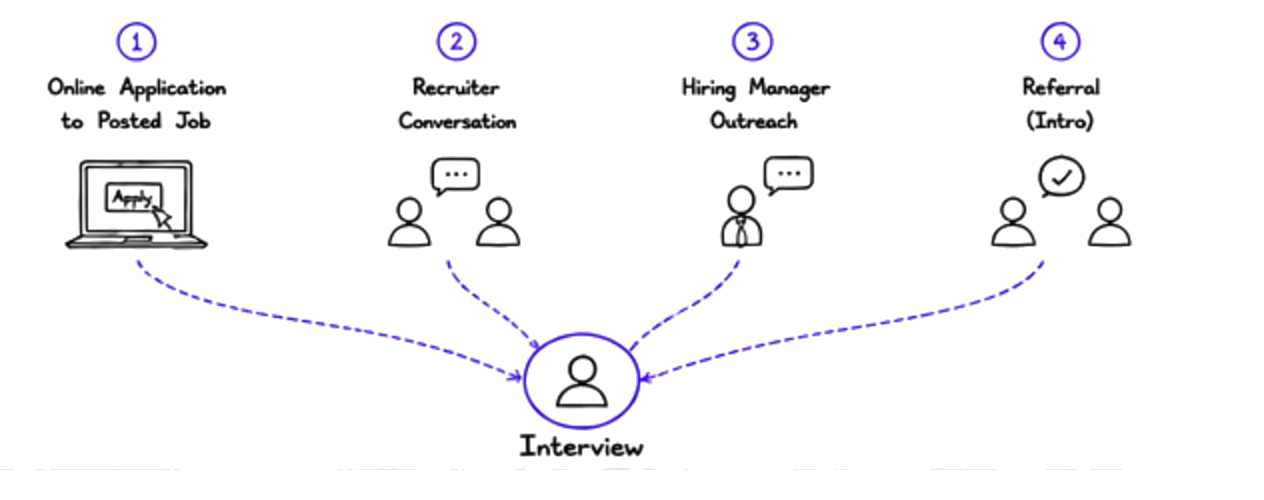
Applications are not opportunities.
Most people rely on one path: applying to posted jobs.
Top candidates create opportunities through multiple paths.
All roads can lead to an interview.
Don't put all your energy in just one.
What CareerCRM does about it
Knowing the market is hidden does not tell you who to write to on a Tuesday morning. That part is the work, and it is the part CareerCRM takes on.
For a role you care about, it surfaces the people best positioned to refer you and ranks them by how close they sit to the hiring team — the engineering manager who owns the function before the recruiter who screens for it. Each contact arrives with a LinkedIn profile and a verified work email, so you can reach them either way.
It then drafts the note in your voice, grounded in your own evidence rather than a template. Nothing sends until you approve it. Nothing is applied to on your behalf.
Next: how to find the hiring manager for a role, or how the whole loop works.
CareerCRM builds your target company list, surfaces relevant people to review, and organizes your application and follow-up workflow — all in one place.
Sign up →